The Voluntary Carbon Credit Market (VCM) has been around since the 1990s and has proven itself to be an important lever for attracting liquidity for the low-carbon transition. In this article, we will explore everything from the fundamentals of carbon credits to the evolution of sustainability trading and strategies for enhancing market integrity.

KATHARINA KISCHISCH
1. Carbon Credits Explained
Carbon credits are a vital component of sustainability initiatives, functioning as tradable permits that represent the reduction or removal of one metric ton of carbon dioxide (CO2) or its equivalent in other greenhouse gases (GHG) from the atmosphere. These credits are typically generated through projects that contribute to emissions reduction or removal. Carbon offset projects are commonly divided into two categories:
- Projects that avoid or reduce carbon emissions (e.g. Afforestation or Reforestation)
- Projects that remove or sequester carbon emissions (e.g. Direct air capture).
Carbon removal and sequestration projects are mostly technology-reliant. Avoidance and reduction credits are nature-based, although there are exemptions to this rule. Both project types are essential to reach net-zero emission in 2050, as certain GHG emissions are unavoidable and hence need to be sequestered to reach net-zero impact.
2. Voluntary Carbon Market History and Demand Analysis
The Voluntary Carbon Market plays a pivotal role in bridging the investment gap for climate mitigation efforts and complements governmental regulations, providing a platform for private actors and companies to procure carbon offsets. Originating in the early 1990s in the United States, the VCM’s history intertwines with the Compliance Carbon Market, which emerged in response to the Clean Development Mechanism under the Kyoto Protocol. This mechanism allowed countries to offset emissions by investing in “Certified Emission Reduction” projects.
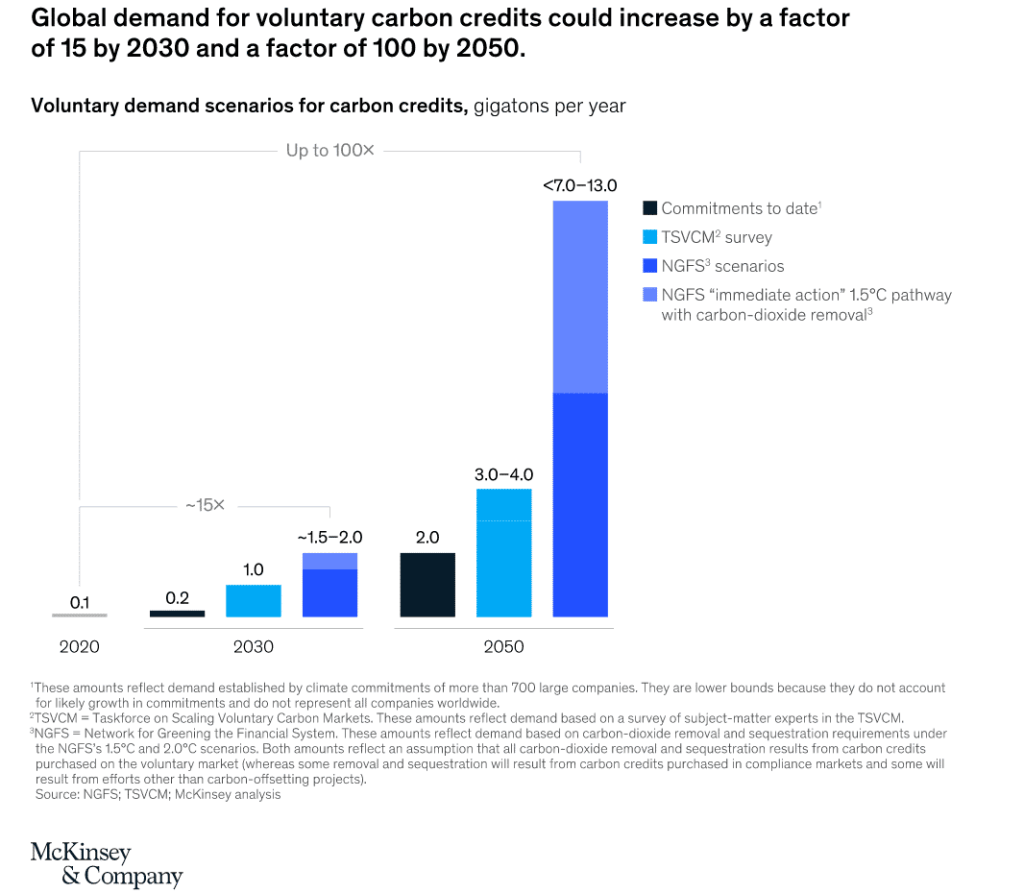
While the Voluntary Carbon Market has existed for decades, its growth surged notably in 2016, expanding by a factor of 10 to reach a record-high valuation of $2 billion in 2021. This growth underscores its ability to attract investments in green technologies and other climate action endeavors, which would otherwise be challenging to monetize without the VCM’s infrastructure.
Currently, companies committing to net-zero emissions by 2050 and other ambitious climate targets represent a significant portion of the global market, amounting to over $20 trillion in market capitalization. More than 30% of Fortune 500 companies have pledged climate actions before 2030. These companies rely on carbon offsets traded in the voluntary carbon credit market to achieve their sustainability goals, highlighting the market’s essential role in driving climate action and sustainability initiatives worldwide. The value of the carbon credit market is forecasted to rise upward of $50 billion in 2030.
3. Fostering Environmental Benefits by Harnessing Market Mechanisms
From an economic perspective, the market faces challenges due to incomplete information. The true value of a “healthy environment” is not factored into market prices, leading to externalization and imposition of negative pollution costs, often disproportionately affecting vulnerable communities impacted by climate change. The principle of “the polluter pays” and internalizing negative externalities is fundamental to carbon credits. This approach holds entities accountable for their environmental impact, requiring them to pay for their pollution. Carbon credits play a crucial role by assigning a monetary value to emissions reductions, encouraging businesses to adopt sustainable practices. This shift in costs incentivizes companies to reduce their carbon footprint. Essentially, carbon credits redistribute the environmental damage burden to those responsible, fostering sustainable development and mitigating climate change.
Additionally, the Voluntary Carbon Credit Market contributes a balanced approach to the economy in climate change mitigation efforts. It introduces a private sector dimension to public and philanthropic investments in climate change counteraction, thereby reducing investment risk in climate incentives and offset projects. By leveraging market mechanisms focused on profit maximization within cost constraints, carbon offsetting projects are strategically planned to achieve maximum impact through efficient resource allocation.
4. Navigating Market Challenges
Certain market mechanisms are hindering the Voluntary Carbon Market from reaching its full potential. Currently, the VCM operates with multiple Standard Setters, often NGOs, responsible for setting stringent quality requirements for carbon offset projects. These approved projects are then registered with serial numbers, accessible to the public. Verra and Gold Standard emerge as the dominant registries, overseeing more than 75% of the VCM’s registered carbon credits. The bottom-up evolution of the VCM without robust governmental regulations, has led to the absence of a unified registry resulting in market heterogeneity that complicates the task of obtaining a comprehensive overview of quality standards for potential buyers.
Furthermore, the incentive structure for registry bodies may contribute to potential over-issuance of carbon credits, as they charge project developers based on the number of approved credits. Criticism in 2023 highlighted concerns about verifying registries, labeling carbon credits as “useless” and accusing purchasing companies of “greenwashing.”
In the current marketplace, carbon credits are predominantly traded through Over-the-Counter (OTC) trades with limited standardization in contracts, lacking a robust secondary market offering increased liquidity, risk mitigation, price transparency, and strategic entry and exit options for companies and individuals alike.
5. Enhancing Market Integrity
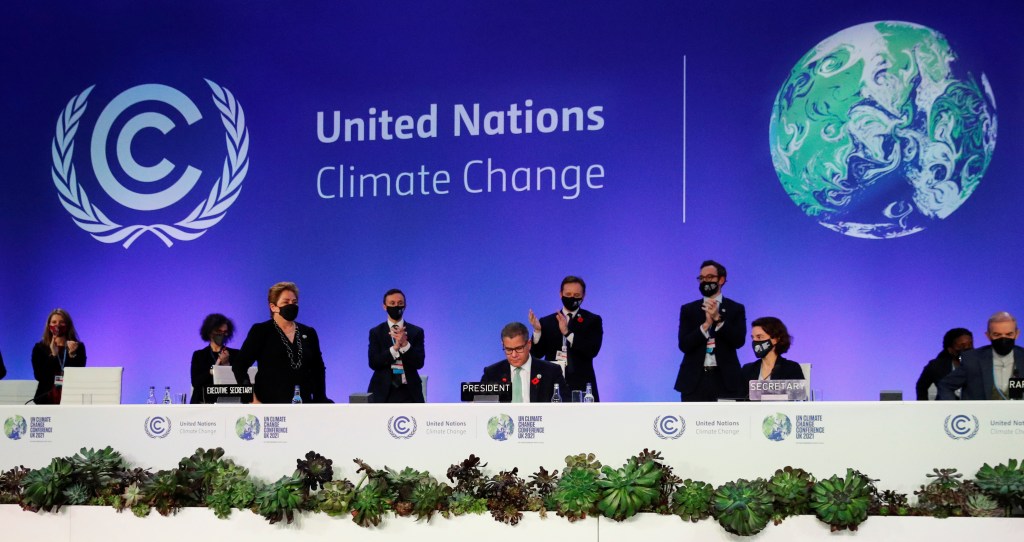
The 2023 UN Climate Change Conference (UNFCCC COP 28) in Dubai, UAE highlighted the upcoming evolution of the carbon credit market, particularly focusing on the establishment of High-Integrity carbon markets. An essential step towards enhancing market integrity is the emergence of the Integrity Council for the Voluntary Carbon Market (ICVCM), an independent governance body for the VCM. The ICVCM aims to set guidelines and standards known as Carbon Credit Principles (CCP) for high-integrity carbon offset projects, ensuring their quality without any charges. Various international market initiatives like the International Sustainability Standards Board, European Sustainability Reporting Standards, US Securities and Exchange Commission, and UK Transition Plan Taskforce have also evolved to improve transparency and accessibility in the VCM.
Additionally, advancements in blockchain technology are fueling proposed enhancements in the carbon credit market. Blockchain enables secure information exchange in decentralized networks, maintaining accountability, transparency, and credibility. As blockchain adoption expands across industries, the next generation of VCM is envisioned as a network of decentralized markets connecting at regional and national levels. Research and focus on Digital Measurement, Reporting, and Verification (dMRV) technologies are underway, supported by organizations like the Finance Corp (IFC) and the International Emissions Trading Association, with a particular emphasis on blockchain use in carbon credit trading.
The collective goal is to establish a new architecture for more significant, liquid, and adaptable transactions across diverse climate markets. Blockchain-based distributed ledgers offer transparency, rule enforcement via smart contracts, and global emission data tracking, paving the way for a more efficient and trustworthy carbon credit market.
Concluding Thoughts
The Voluntary Carbon Credit Market (VCM) is not just a financial instrument; it’s a pivotal lever for steering the global economy towards sustainability.
With roots dating back to the 1990s, the VCM has evolved into a multi-billion-dollar industry, attracting investments in green technologies and driving climate action worldwide. The recent discussions at the 2023 UN Climate Change Conference (UNFCCC COP 28) in Dubai underscored the market’s transformative journey towards High-Integrity carbon markets.
One of the key developments is the establishment of the Integrity Council for the Voluntary Carbon Market (ICVCM), an independent governance body focused on setting high standards through Carbon Credit Principles (CCP) without imposing charges. This initiative, along with advancements in blockchain technology and Digital Measurement, Reporting, and Verification (dMRV) technologies, promises a future where transparency, accountability, and credibility are paramount in carbon credit trading.
Despite facing challenges such as market heterogeneity and criticism over verification processes, the VCM remains a crucial tool for companies committing to net-zero emissions and sustainability goals. As more industries and organizations embrace carbon offsetting, the demand for high-quality and high-integrity carbon credits continues to rise. The VCM’s anticipated transformation signals a shift towards a more efficient, liquid, and adaptable market that not only fosters sustainable development but also mitigates climate change effectively.
Read our whitepaper to discover how TO2KEN takes on social responsibility and participates as an avant-garde in the transformation of the Voluntary Carbon Market.
Offset Flow
Carbon Credits & Net-Zero. TOGETHER.
Menú








 Offset Flow
Leave a comment